The topic of our next post, in our 'What is' series is 'diamond colour', we explain the process of grading using the Gemological Institute of America's (GIA) colour scale.
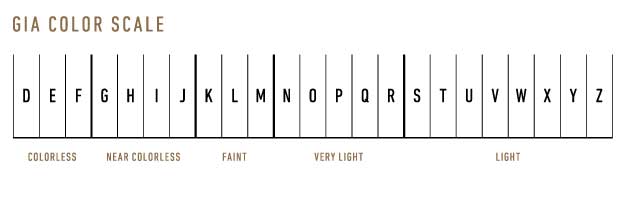
Diamonds are not graded by the presence of colour, but rather the absence. A diamond with the presence of colour is deemed less valuable (other than diamonds that lay outside the D-Z hue (shown below), which are known as 'fancy coloured', more on these types of diamonds in a future post). The below describes the D-Z diamond colour chart.
 (Picture source: GIA - http://www.gia.edu/gia-about-4Cs-Color)
The above colour scale was formed by the GIA to create international consistency with diamond colour grading. The GIA diamond grading scale starts at the letter D, as before there were numerous grading systems used in the early grading systems, some using the letters A, B and C, others using numbers and some using numerals. To make things clearer, the GIA started their grading system at D to ensure consistency and eradicate confusion from previous systems. Below we explain the different segments of the scale;
Colourless (D, E & F) - These diamonds are the rarest of white diamonds, the difference between D, E & F diamonds is extremely hard to detect, even to the trained eye.
Near colourless (G, H, I & J) - Diamonds of these colour offer extremely great value for money. When placed within white metal, the colour difference often becomes nominal, especially in natural daylight.
Faint colour (K, L & M) - This shade of diamond is quite inexpensive and noticeable to the naked eye, these shades of diamonds are sometimes described as warm-coloured. When set within yellow gold, the appearance of the colour can often be masked.
Very light colour (N, O, P, Q & R) - These grades of yellow or brown diamond colour are more noticeable to the naked eye. They are also quite inexpensive, providing great value for money.
Light colour (S, T, U, V, W, X, Y & Z) - These shades of diamond colour are often too extreme for most customers, although should this be preferred then these diamonds offer phenomenal value for money, with large diamonds becoming extremely cost effective.
Although diamond colour is graded using the above system, there are other factors which can affect a diamonds colour appearance. Diamonds with a brownish or greenish tinge can be graded on the above colour grading system as long as the diamond's hue is less than the G master stone, the GIA states the following:
'When a diamond has the same amount as—or more color than—the G master (i.e., moves out of the colorless to the near-colorless range) and shows a hue such as pink, blue, or green, it will be graded as a colored diamond'
Fancy coloured diamonds are graded on a separate scale to the D-Z coloured range. The above scale grades on the absence of colour, however fancy coloured diamonds are graded on their presence and intensity of colour. The below chart represents the system of grading fancy coloured diamonds.

(Picture source: http://www.gia.edu/fancycoloreddiamond-quality-factor)
There are various levels of fancy coloured diamonds, with the intensity of the colour giving more value to the diamond, also distribution of the colour being even across the diamond will also inherit a larger value. Diamonds with other shades than yellows and browns are extremely rare, these diamonds also fetch a significantly higher price compared to their yellow and brown counterparts.
More information on fancy coloured diamonds will be available in a later post.
Diamond colour is not as simple as black and white, there are many influencing factors which can affect a diamond's appearance. There are also many factors which also have to be considered when grading diamond colour.
Choosing the correct colour of diamond is a personal affair, with some liking the purest white colours and others falling in love with vibrant colours radiating from the warmer colours. We recommend a visit to a local jeweller to get a feel for the colour spectrum and asking to see a variety of shades.